Featured
Table of Contents
Deepness therapy is a healing practice based upon the job of Swiss psychiatrist Carl G. Jung. Depth treatment is started on the belief that the majority of psychological health and wellness issues are brought on by unconscious motivations which exposing and checking out these motivations is the essential to healing. There are many different methods that drop under the umbrella of deepness therapy, one unifying goal of therapists who specialize in deepness therapy is to integrate the unconscious mind with the mindful.
Psychology is developed around the study of the human mind, which several noticeable psycho therapists have believed to be affected by the subconscious. Depth psychology is a branch of psychology that explores the unconscious elements of the human psyche to comprehend the underlying inspirations and feelings that drive behavior. The unconscious mind is a key part of depth psychology.
Deepness psychologists typically see the human mind as both mindful and subconscious, and psychoanalysis is generally their major psychotherapeutic approach. There is a belief that discovering subconscious pressures can be intrinsically recovery.
Reducing Lasting Trauma Symptoms

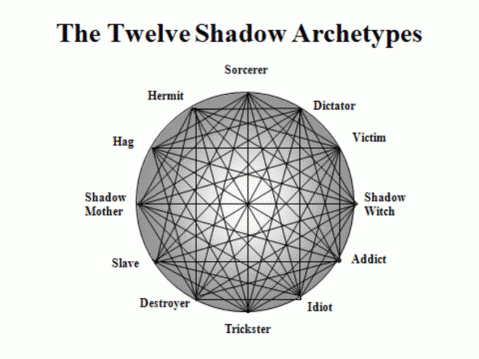
As component of his job, Jung relied on a deeper cumulative subconscious and representative archetypes. The cumulative subconscious, according to Jung's depth emotional viewpoint, helps describe our disposition towards myth-making and fantasizing. Underlying this combination is the concept that the human subconscious is partially conscious and partly subconscious, keeping experiences and issues that might have been repressed, together with cumulative and archetypal pressures.
Your therapist can offer support as you make modifications in just how you react and can aid you with considerably tough situations. Depth pyschotherapy is fit to individuals who wish to deal with deep-rooted mental and psychological obstacles, along with injury. Also, there may be behaviors that you remain to duplicate despite the fact that they are harming to you.
Accessing Payment Support for Trauma Treatment
You may require to be inspired and patient throughout the procedure, yet it may aid you find more about yourself via an expedition of your unconscious thoughts. This process may assist with any type of life tests you are facing and aid you relocate forward with greater understanding.
Bleuler was the director of the Burghlzli Asylum in Zrich, where Carl Jung began his job. Analysts like Sigmund Freud, Alfred Adler, and Otto Ranking added to the development of this area. However, this area is most closely related to Jung's work. The techniques of this first wave of psychology look for to surpass behavior and cognitive procedures to the unconscious inspiring factors underneath them (hence the term "depth").
By bringing the unconscious material of the specific to consciousnessboth individual and collectiveone moves from fragmentation and "one-sidedness" towards wholeness. Jung thought that we were all looking for the very same thing: the soul. From his view (and straight experience), one needs to accept one's inner worldexploring one's dreams and imaginationto at some point show up at a stage of integrity where one's soul is realized.
Facilitating Your Image Transformation therapy Journey
With each other, they stand for opposing forcesyin and yang. For this reason, the practitioners of depth psychology needed to establish a new language for studying and translating symbols and new approaches for connecting via photos. Balancing the opposites can be challenging, as it needs an alchemical process that inevitably leads to mental combination.

To learn more about one's shadowthe parts of oneself that a person is cut off and divorced fromrequires repetitively confronting the ego's identity. Depending upon one's degree of internal resistance and will, this procedure can be testing for numerous people. For this reason, professionals like Jung (and scholars like Joseph Campbell) consider it a "brave act" to bridge the void in between the mindful and the unconscious.
Freud was grooming the younger Jung to be his follower. Yet both males really did not see eye to eye. (Ultimately, their expert relationship ended rather quickly.) Prior to their separation, Sigmund Freud called his area psychoanalysis, as in the study of psychotic and mentally ill individuals. Jung suggested a different name for their emerging area: psyche-analysis.
Jung saw their role as an analysis of the human mind, soul, and spirit. That is, Jung saw an extremely different image of the human condition than Freud.
Following Trauma Treatment in Auburn, CA
Jung believed that we are ALL fragmented and divided, and intentionally or otherwise, we're all looking for our hearts. This look for one's soul is at the facility of depth psychology. Sigmund Freud (facility) and Carl Jung (ideal) in 1909Credit: Wellcome Collection, London. Wellcome Images The understandings originated from analytic concept are, essentially, found outside academic community.
D. in psychology, you aren't most likely to interact with Jungian concept other than maybe in a background course (where they educate you that psychoanalysis was the "initial wave"). The scholastic area of psychology is, as Jung would claim, discriminatory. It's virtually exclusively focused on the mindful mind (what he called the thinking function).
It makes sensemost people run completely within the conscious mind, the realm of the ego. Right here, the ego is in cost and tries to manage itself and its environment. Depth psychology, on the other hand, requires us to connect with the subconscious domainto get in the commonly ambiguous world of signs, images, and feelings.

Latest Posts
Managing Anxiety for OCD through Anxiety therapy
Supporting Waterloo, Ontario Multicultural Residents With Culturally Informed Therapy
Diagnostic Evaluation Services in Ashburn, VA